

Explore our turnkey CBTA training portfolio
Designed by Airbus operational flight experts, our turnkey CBTA flight training portfolio supports airlines across all aircraft fleets. Transition from traditional task-based training to a modern standard focused on real-world competencies, observable behaviours and effective decision-making in the cockpit.


Instructor and trainees in a classroom
Instructor and trainees in a classroom
Instructor and trainees in a classroom
What is CBTA and why should your airline transition?
Competency-Based Training and Assessment (CBTA) is an ICAO- and IATA-recommended methodology designed to build resilient, threat-prepared flight crews.
Unlike traditional task-based methods that evaluate discrete manoeuvres, CBTA focuses on holistic pilot performance, threat and error management (TEM), and observable behaviours during unexpected operational scenarios. With National Aviation Authorities (NAAs), EASA and ICAO setting strict implementation frameworks, transitioning to CBTA ensures your airline stays compliant while maximising flight safety.
Discover the Airbus advantage below:
The 9 ICAO core pilot competencies evaluated in CBTA
Knowledge (KNO)
Demonstrates thorough aircraft system knowledge
Application of Procedures (PRO)
Demonstrates strict aircraft compliance with operational procedures
Communication (COM)
Ensures clear, concise, and operational communication across multi-crew environments
Flight Path Management – Manual (FPM-M)
Controls aircraft trajectory with smooth precision, proper energy management and attitude control
Flight Path Management – Automation (FPM-A)
Effectively manages automated flight systems to optimise flight path control
Leadership & Teamwork (LTW)
Fosters collaborative crew decision-making and optimal task sharing
Problem Solving & Decision Making (PSD)
Identifies operational risks, analyses options and makes timely, well-informed decisions
Workload Management (WLM)
Prioritises and manages workload efficiently to prevent task saturation in high-stress situations
Situation Awareness (SAW)
Monitors aircraft status, weather and operating environment for full situational awareness

Is CBTA the Future of pilot training?
Airbus' Head of Pedagogy & Standards provides his insight.


Instructors and trainees in training rooms
CBTA Developer Course
Designed for beginner and intermediate levels, including flight operations engineers and instructor profiles.
Objective: Learn how to design and develop a flight training course using CBTA methodology
Duration: 10-day classroom course
Prerequisites: Aviation training experience or flight operations background
Fleet compatibility: Applicable to all aircraft fleets (Airbus, Boeing, etc.)
Location: Airbus Training Centre or at your premises


Instructors and trainees in training rooms
CBTA Instructor Standardisation Course
Designed for airline instructor profiles.
Objective: Standardise instructors to effectively assess, grade and manage data under CBTA principles
Duration: 5 days (3 days in-classroom training for CBTA awareness + 2 days on a flight simulation training device)
Prerequisites: Airbus instructor experience
Fleet compatibility: Applicable to Airbus fleets
Location: Airbus Training Centre or at your premises


Instructors and trainees in training rooms
Instructors and trainees in training rooms
Instructors and trainees in training rooms
CBTA Advisory Service
Tailored for airline CBTA implementation project teams.
Objective: Expert consulting on course development methodology in accordance with the ADDIE (Analyse, Design, Develop, Implement, Evaluate) model and delivery of practical and theoretical training
Duration: Determined by project scope
Fleet compatibility: Applicable to Airbus fleets
Location: At your premises or via videoconference
Frequently Asked Questions
What is CBTA in aviation?
CBTA (Competency-Based Training and Assessment) is an ICAO training methodology that evaluates pilot performance based on core competencies and real-world scenarios.
What is the difference between EBT and CBTA?
CBTA is the overarching competency-based training framework. EBT (Evidence-Based Training) is a specific application of CBTA used for recurrent training, driven by operational flight data to target actual operational risks.
How does CBTA differ from traditional pilot training?
Traditional pilot training focuses on repeating standard manoeuvres to pass a test. CBTA evaluates overall pilot proficiency, decision-making and threat management across flexible, realistic operational scenarios.
Is CBTA mandatory under EASA and FAA rules?
EASA is currently developing regulations, expected by 2029, to approve CBTA ATOs. The FAA considers their current training scheme "AQP" (Advanced Qualification Program) is already in line with CBTA ICAO guidance.
How long does it take to deploy a CBTA framework?
Deployment timelines depend on fleet size and regulatory approvals. However, adopting Airbus’ ready-to-use frameworks and turnkey documentation enables operators to reduce deployment time by up to 6 months compared to developing a framework from scratch.
Are Airbus CBTA courses only for Airbus aircraft?
No. While natively tailored to Airbus aircraft philosophies, Airbus’ CBTA developer courses, instructor standardisation and advisory services are compatible with multiple fleets and applicable to other aircraft operators.
What resources does Airbus provide to support CBTA implementation?
To empower operators towards full autonomy in CBTA deployment, Airbus delivers an end-to-end implementation package covering CBTA courseware development, instructor standardisation, expert consulting and change management for seamless fleet deployment.
How do Airbus CBTA programmes ensure regulatory compliance?
Airbus CBTA frameworks are developed in direct alignment with ICAO and EASA standards. As the OEM, Airbus builds its training directly from aircraft design data, FCOM guidelines, global fleet safety analytics and customer feedback, ensuring seamless approval from local Civil Aviation Authorities (CAAs) and an operational fit that non-OEM providers cannot match.
How does Airbus CBTA compare to other frameworks?
Airbus CBTA is natively tailored to the Fly-by-Wire (FBW) architecture, cockpit philosophy and operational data of Airbus aircraft, ensuring precise and relevant training framework for Airbus crews.
How do digital tools support Airbus CBTA trainee assessment (grading)?
Together with a partner company, Airbus has developed grading applications to enable real-time evaluation of Observable Behaviours (OBs) by instructors, reducing grading subjectivity and emphasising individual pilot needs.
What return on investment (ROI) does CBTA offer airlines?
CBTA improves training efficiency, reduces failure rates during line checks and enhances fleet safety by targeting root-cause operational risks instead of repeating mastered tasks.
Contact our CBTA Experts
Ready to upgrade your flight crew training? Contact our team of experts to request a quote or tailor a CBTA solution for your airline.
Discover more about training services
-
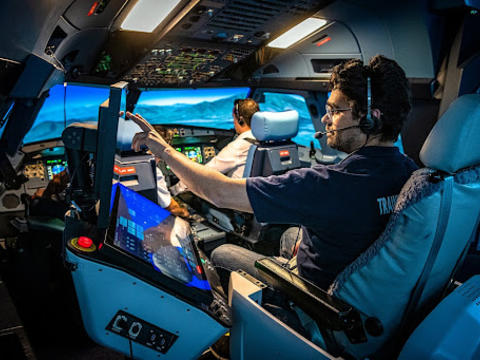
Evidence Based Training (EBT)
Allows your instructors to reduce their downtime and line check time, while benefiting from a complete EBT Training System.
-
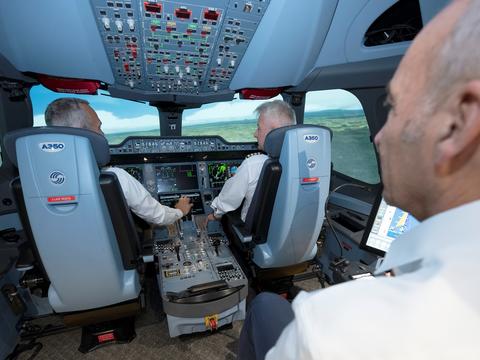
Type Rating
The modules provide the student with a smooth transition from a basic flight environment to a complex flight environment.
-
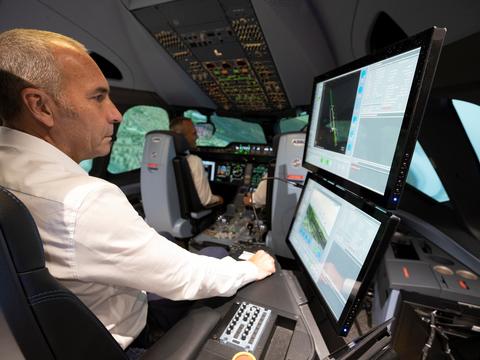
Instructor and Examiner Courses
We offer a unique, highly appreciated people-centred programme to train-the-trainer.


